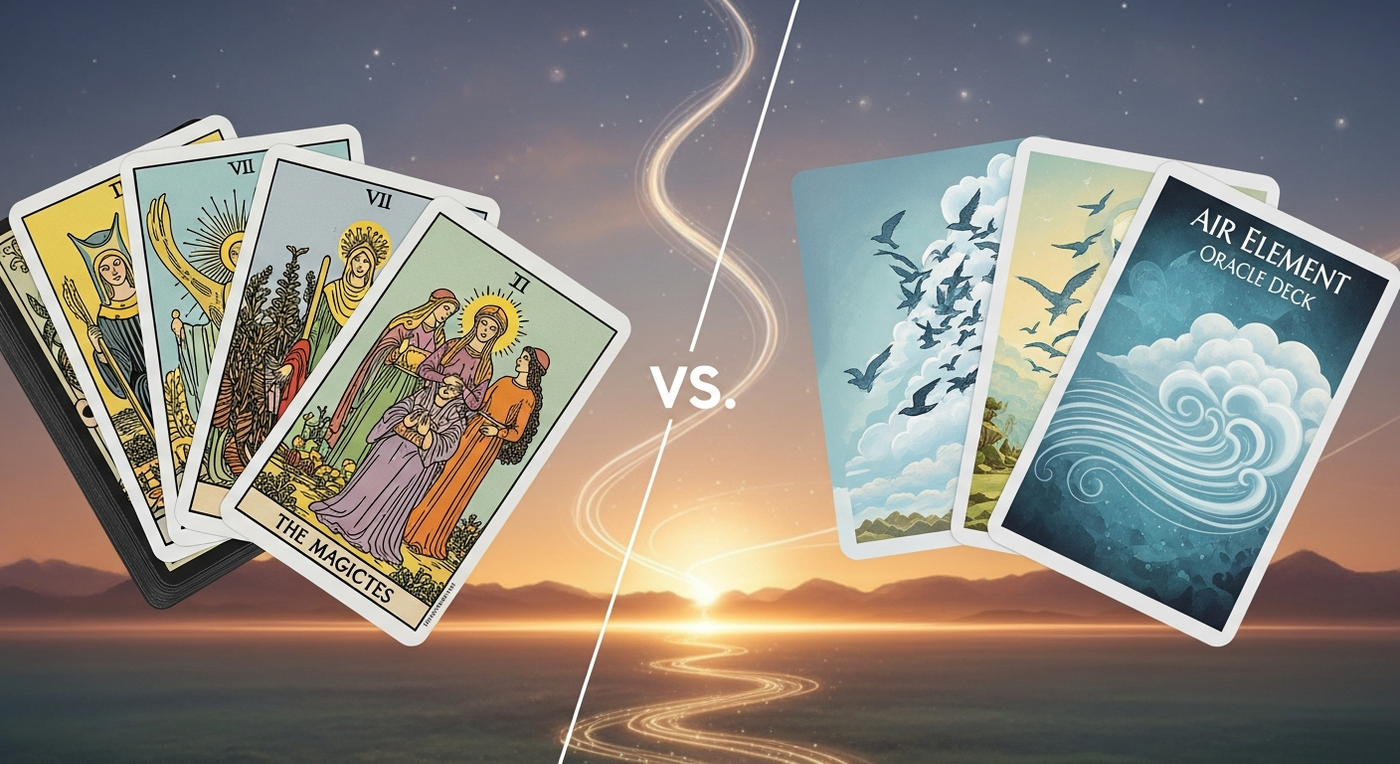
Air Element Oracle Deck vs. Traditional Tarot: Unveiling the Unique Wisdom of Elemental Guidance
Introduction: Navigating the Realms of Divination
The Evolving Landscape of Spiritual Tools
In today's rapidly evolving spiritual landscape, the quest for self-understanding and inner wisdom has led many to embrace a diverse array of tools. From ancient texts to modern practices, individuals are seeking pathways to deeper connection, clarity, and personal growth. Among the most beloved and accessible of these tools are divination systems, with tarot decks and oracle cards standing at the forefront. While tarot has enjoyed centuries of established tradition and widespread recognition, a new wave of spiritual seekers is discovering the unique power and intuitive resonance offered by oracle decks. This shift reflects a growing desire for more personalized, fluid, and energetically attuned guidance.
Introducing the Elemental Oracle: A Fresh Perspective
Enter the Elemental Oracle Deck, a groundbreaking system designed to tap into the primal forces that shape our reality. Moving beyond the structured symbolism of traditional decks, this oracle offers a direct conduit to the fundamental energies of Earth, Air, Fire, and Water. Each element, with its distinct vibration and wisdom, provides a unique lens through which to explore life's challenges and opportunities. Our focus today is on the profound insights offered by the Air element, a domain of intellect, communication, and swift inspiration. By grounding our understanding in these core elemental forces, the Elemental Oracle deck provides a fresh and potent perspective on self-discovery.
The Core Question: Oracle vs. Tarot
As more individuals explore these rich spiritual modalities, a common question arises: What truly differentiates an oracle deck from a traditional tarot deck? This exploration delves into the heart of this inquiry, specifically examining the unique wisdom offered by an elemental oracle, with a particular emphasis on the Air element, in contrast to the established framework of tarot. We aim to illuminate the distinct approaches, interpretative styles, and the specific types of guidance each system provides, directly addressing the search intent behind "elemental oracle vs tarot" and understanding how these systems offer complementary paths to wisdom.
Understanding Traditional Tarot: Structure and Symbolism
The Archetypal Journey: Major and Minor Arcana
Traditional tarot decks are built upon a sophisticated and intricate structure, comprising 78 cards divided into two main sections: the Major Arcana and the Minor Arcana. The 22 Major Arcana cards represent universal archetypes and significant life lessons, charting a profound journey of spiritual and personal development. These cards, such as The Fool, The Magician, and The World, speak to pivotal moments, overarching themes, and the grand cycles of existence. Complementing this grand narrative are the 56 Minor Arcana cards. These are further divided into four suits, each reflecting different facets of daily life and experience. They offer detailed insights into the more mundane, yet equally important, aspects of our journey, providing context and nuance to the overarching themes presented by the Majors.
The Four Suits of Tarot: A Foundation of Meaning
The four suits of the Minor Arcana form the backbone of tarot's interpretative framework. While variations exist, the most commonly recognized suits are Wands, Cups, Swords, and Pentacles (or Coins/Disks). Each suit is generally associated with a specific element and a particular domain of human experience:
- Wands: Often linked to the element of Fire, Wands represent passion, creativity, inspiration, ambition, and action. They speak to our drive, our spirit, and our ability to manifest our desires.
- Cups: Associated with the element of Water, Cups delve into emotions, relationships, intuition, love, and the subconscious. They are the suit of feelings, empathy, and the ebb and flow of our inner world.
- Swords: Connected to the element of Air, Swords deal with the intellect, thoughts, communication, conflict, and challenges. They represent logic, mental clarity, truth, and the sometimes sharp realities of decision-making.
- Pentacles: Often aligned with the element of Earth, Pentacles focus on the material world, finances, career, health, and practicality. They are the suit of grounding, security, abundance, and tangible results.
This four-suit system provides a structured and historically rich method for interpreting the myriad situations and energies that arise in life.
Tarot's Historical Roots and Established Interpretations
The history of tarot is a fascinating tapestry woven with threads of cartomancy, art, and esoteric philosophy, stretching back to the mid-15th century. Initially used as a card game, tarot gradually evolved into a powerful tool for divination and self-exploration. Over centuries, a vast body of knowledge, symbolism, and established interpretations has accumulated around its cards. Renowned decks like the Rider-Waite-Smith have become cornerstones, with their detailed imagery and well-documented meanings forming the basis for countless readings and educational resources. This deep historical lineage lends tarot a profound gravitas and a wealth of established symbolism that practitioners can draw upon, making it a robust system for those who appreciate its structured approach and rich interpretive tradition.
The Elemental Oracle: A Framework of Pure Energy
Beyond Suits: The Primal Forces of Earth, Air, Fire, and Water
In stark contrast to the suit-based structure of tarot, the Elemental Oracle Deck operates on a foundational principle of pure elemental energy. Instead of navigating through the distinct domains of Wands, Cups, Swords, and Pentacles, this oracle invites users to connect directly with the primal forces of Earth, Air, Fire, and Water. These four elements represent the fundamental building blocks of existence, each possessing a unique vibration, essence, and set of influences that permeate our lives. By focusing on these core energies, the Elemental Oracle offers a more direct and intuitive pathway to understanding the energetic currents at play, bypassing the need to decipher intricate suit associations and instead tapping into the raw power of nature's forces.
The Air Element: Wisdom, Intellect, and Communication
Within the Elemental Oracle, the Air element stands as a beacon of clarity, intellect, and connection. It is the realm of thought, ideas, and inspiration, governing our mental processes, our ability to communicate, and the flow of information. Air represents the swift movement of the wind, carrying messages, sparking innovation, and promoting objective understanding. When the Air element manifests in a reading, it signals a need for clear thinking, open communication, and the embrace of new perspectives. It encourages us to engage our intellect, to articulate our thoughts precisely, and to remain open to the breezes of inspiration that can lead to breakthroughs and novel solutions. Understanding the wisdom of the Air element is crucial for navigating the mental and communicative landscapes of our lives.
The Oracle's Approach: Intuitive Guidance and Energetic Resonance
The Elemental Oracle is designed to facilitate a deeply intuitive and energetically resonant experience. Its strength lies in its ability to offer guidance that feels immediate and personally relevant, directly tapping into the prevailing elemental energies. Unlike tarot's often complex symbolic language and narrative structures, the oracle's approach is more fluid and impressionistic. The cards are crafted to evoke a feeling, a vibration, that aligns with the specific elemental essence they represent. This allows for a more personal interpretation, where the user's intuition plays a more prominent role in decoding the message. The goal is not to fit a card into a pre-defined meaning but to feel its energetic signature and understand how it resonates with your current situation, particularly in how it illuminates aspects of Air's domain – your thoughts, your communications, and your intellectual clarity. This direct energetic connection makes the Elemental Oracle a powerful tool for those seeking swift insights and a more organic form of guidance, especially when exploring the nuanced messages of the Air element.
Key Differences in Approach and Interpretation
Structure vs. Flow: Fixed Meanings vs. Energetic Signatures
The fundamental divergence between an elemental oracle and traditional tarot lies in their interpretative frameworks. Tarot, with its 78 cards, operates on a system of established, often narrative-driven meanings. Each card, whether from the Major or Minor Arcana, carries a wealth of historical and symbolic interpretation. A spread in tarot, such as the Celtic Cross, guides the user through a structured narrative, with each position offering a specific facet of the question's unfolding. This approach provides a robust and detailed analysis, akin to a well-researched report.
In contrast, the Elemental Oracle prioritizes energetic signatures and intuitive resonance. While individual cards represent core elemental energies, their interpretation is less about rigidly defined meanings and more about the felt sense of that energy in relation to the question. This is particularly evident when considering the Air element. Tarot's Suit of Swords can indicate mental conflict or sharp truths, but the Air element in an oracle might manifest as a swift gust of inspiration, a need for mental agility, or a communication blockage that feels palpable. The oracle’s strength lies in its fluidity, allowing for a more immediate and personalized connection to the energetic currents, especially when those currents relate to intellectual and communicative aspects, offering a distinct advantage in understanding elemental oracle vs tarot for those seeking direct energetic feedback.
Narrative Arc vs. Elemental Snapshot
Tarot decks are inherently narrative. The Major Arcana, in particular, charts a hero's journey, a progression of lessons and experiences. A tarot reading can feel like tracing a story, revealing the past influences, present challenges, and potential future outcomes in a sequential, often cyclical, manner. This narrative depth is invaluable for understanding the overarching themes and the unfolding journey of a situation.
The Elemental Oracle, however, offers more of an "elemental snapshot." It provides a powerful, immediate view of the energetic forces at play right now. When an Air card appears, it's not necessarily about a long-term intellectual struggle but perhaps a sudden insight that is crucial in this moment, or a communication that needs to be handled with extreme care and clarity. This offers a different kind of wisdom – one that is highly relevant to the present energetic landscape and the immediate actions or shifts in perspective required. It’s less about the grand narrative and more about the potent, present energetic influences, making it ideal for quick, incisive guidance.
Learning Curve and Accessibility
The extensive symbolism, historical context, and intricate relationships between cards in tarot can present a significant learning curve. Mastering tarot requires dedication to study, memorization, and practice to fully grasp its nuanced meanings and interpretive techniques. While this depth is a draw for many, it can also be a barrier to entry for newcomers or those seeking more immediate access to guidance.
Elemental oracles, by their nature, tend to be more intuitively accessible. By focusing on core elemental energies, the user can often connect with the cards' messages on a more visceral level. The imagery and symbolism within an oracle deck are often designed to evoke a direct energetic response, making it easier for individuals to tap into their own intuition. For instance, understanding the Air element's message of clarity or communication in an oracle might come through a feeling of lightness, a sudden thought, or a sense of openness that requires less prior knowledge of specific card meanings, making the elemental oracle vs tarot debate often hinge on this accessibility factor for beginners.
The Role of Air Element Wisdom in the Oracle Deck
Air as the Oracle of Clarity and Intellect
In the Elemental Oracle Deck, the Air element is the undisputed sovereign of intellect, communication, and mental clarity. Its presence in a reading signals a need to engage our rational minds, to communicate with precision, and to embrace objective perspectives. Air cards illuminate our thought processes, highlighting areas where we might be experiencing mental fog, where communication channels are open or blocked, or where innovative ideas are waiting to take flight. This element is the swift breeze that clears away confusion, the sharp wind that cuts through illusion, and the gentle whisper of inspiration that sparks new pathways of thought.
Practical Applications: Decision Making and Communication
The wisdom of the Air element, as conveyed through the oracle, offers profound practical applications. When faced with a complex decision, an Air card can prompt us to step back, analyze the situation objectively, and gather all pertinent information before committing. In communication, Air encourages us to speak our truth with clarity and kindness, to listen actively, and to ensure our message is received as intended. It can also highlight the need for intellectual curiosity, urging us to learn, to explore new ideas, and to remain open to different viewpoints. For instance, a reading indicating a strong Air influence might advise you to draft an email with extra care, to engage in a thoughtful debate, or to seek out a mentor for intellectual guidance.
Distinguishing Air's Influence from Tarot's Swords
While both the Air element in the oracle and the Suit of Swords in tarot deal with the mental realm, their approaches and nuances differ. Tarot's Swords can often represent conflict, sharp truths, and difficult decisions that carry a sense of weight and consequence. They speak to the challenges of the mind and the often painful process of confronting reality. The Air element in the Elemental Oracle, while acknowledging these aspects, often emphasizes the flow and movement of thought and communication. It's less about the static conflict and more about the dynamic exchange of ideas, the clarity of thought required, or the inspiration that can arise from mental activity. An Air card might suggest a breakthrough in understanding, whereas a Sword card might point to the struggle to reach that understanding. This distinction is crucial for understanding the unique value proposition of the elemental oracle vs tarot when focusing on specific energetic influences.
Who Benefits Most from Each System?
For the Deep Dive: Tarot Enthusiasts and Storytellers
Traditional tarot holds immense appeal for those who appreciate depth, structure, and a rich historical lineage. Enthusiasts who enjoy delving into complex symbolism, tracing archetypal journeys, and weaving intricate narratives from their readings will find tarot to be an inexhaustible source of wisdom. Tarot is ideal for individuals who seek to understand the long-term unfolding of their lives, the karmic patterns at play, and the profound spiritual lessons embedded within the human experience. Those who view their spiritual practice as a form of storytelling, seeking to understand the plot, characters, and overarching themes of their life's narrative, will find tarot to be their most resonant companion.
For the Quick Insight: Oracle Seekers and Intuitive Navigators
Elemental oracles, with their direct energetic approach and intuitive accessibility, are perfectly suited for seekers who desire swift, clear, and personally resonant guidance. Individuals who trust their intuition implicitly and prefer a more fluid, impressionistic style of divination will gravitate towards oracles. They are ideal for those who need to cut through complexity and receive immediate insights into their present energetic landscape, especially when seeking the focused wisdom of a particular element like Air. Oracle users often seek to understand the energetic "now" and how to best navigate it, making them excellent tools for quick check-ins, moment-to-moment clarity, and intuitive navigational support.
The Complementary Nature: Using Both for Holistic Guidance
It is crucial to recognize that these systems are not mutually exclusive; rather, they are beautifully complementary. A seasoned practitioner might use tarot to map out the overarching journey of a project or relationship, identifying the core archetypal energies and long-term trajectories. Then, they might turn to an Elemental Oracle, perhaps focusing on the Air element, to gain immediate insights into the current communication dynamics, mental blocks, or innovative sparks relevant to that project. This integrated approach offers a holistic perspective, combining the narrative depth of tarot with the potent, immediate energetic wisdom of an elemental oracle, providing a more comprehensive understanding of life's multifaceted energies.
Practical Examples: A Sample Reading Comparison
Scenario: Seeking Clarity on a New Project
Question: "What are the key considerations for the success of my new creative project?"
Tarot Reading (Hypothetical): A spread might reveal The Magician (for skill and manifestation), followed by the Three of Swords (indicating potential heartbreak or difficult truths to confront), and concluding with the Ten of Pentacles (suggesting long-term abundance and legacy).
Interpretation: This tarot reading suggests that while you possess the skills to manifest this project (The Magician), there will be significant emotional challenges or difficult realizations along the way (Three of Swords). However, if these are navigated successfully, the project has the potential to lead to lasting fulfillment and tangible success (Ten of Pentacles). The emphasis here is on the unfolding narrative, the lessons learned, and the eventual outcome.
The Elemental Oracle's Perspective on the Same Scenario
Elemental Oracle Reading (Hypothetical): The same question is posed. The oracle draws: Air, Earth, and Fire.
Interpretation: The Air card immediately highlights the importance of clear communication and intellectual strategy. It suggests that the success of this project hinges on your ability to articulate your vision effectively, to engage in open dialogue with collaborators, and to maintain mental agility in the face of new information. The Earth card points to the need for grounding and practical planning. It emphasizes building a solid foundation, ensuring resources are managed wisely, and staying focused on tangible steps and achievable milestones. Finally, the Fire card ignites the passion and drive necessary to bring this project to life. It signifies the need for enthusiasm, bold action, and creative energy to overcome inertia and manifest your ideas.
Comparing the Nuances of Air-Centric Advice
Notice the difference in focus. The tarot reading provides a narrative arc, emphasizing emotional challenges and long-term rewards. The Elemental Oracle, particularly with the strong presence of the Air card, offers direct, actionable advice centered on the process of intellectual engagement and communication. It’s not about the potential heartbreak itself, but about how your communication and mental approach can mitigate or navigate such challenges. The oracle’s Air element provides immediate insight into the "how" of thinking and communicating for success, whereas tarot might focus more on the "what" and "why" of the overall journey. This makes the elemental oracle vs tarot comparison particularly illuminating when seeking specific energetic guidance on immediate mental and communicative strategies.
Conclusion: Embracing the Right Tool for Your Journey
Recap of Key Distinctions
We've explored the profound differences between traditional tarot and elemental oracle decks, highlighting their unique strengths and approaches to divination. Tarot, with its structured 78 cards, Major and Minor Arcana, and established historical interpretations, offers a deep, narrative-driven journey through life's archetypes and lessons. Elemental oracles, such as the Elemental Oracle Deck, cut to the core of energetic wisdom, focusing on the primal forces of Earth, Air, Fire, and Water. They provide more fluid, intuitive, and energetically resonant guidance, with the Air element specifically offering potent insights into intellect, communication, and mental clarity.
Choosing Your Path: Intuition and Intent
The choice between tarot and an elemental oracle, or the decision to integrate both, ultimately rests on your personal journey, your intuition, and your specific intentions. If you seek a comprehensive, layered understanding of life's grand narratives and archetypal lessons, tarot may be your primary guide. If you crave swift, direct, and energetically attuned insights, particularly when navigating your thoughts and communications, the Elemental Oracle, with its potent Air element wisdom, will serve you exceptionally well. Consider what kind of guidance resonates most deeply with you at this moment.
The Power of Elemental Wisdom
The Elemental Oracle Deck, by grounding its wisdom in the fundamental forces of nature, offers a unique and powerful pathway to self-discovery. The Air element, in particular, provides an invaluable lens through which to understand our mental landscapes, our communication styles, and our capacity for innovation and clarity. By embracing the distinct wisdom of elemental guidance, we unlock new dimensions of understanding and empower ourselves to navigate our lives with greater intention and insight. Whether you are a seasoned seeker or new to divination, the Elemental Oracle offers a direct connection to the potent energies that shape our world and our inner lives.